Why Work with CCV?
Our team at the Center for Computation and Visualization (CCV) is composed of skilled data scientists, research software engineers, and system administrators. We believe in forming meaningful partnerships with researchers, whether your project spans weeks, months, or years. With us, you can expect long-term stability and adaptable support as your research landscape evolves.
Working with CCV means you can benefit from:
- Diverse Technical Expertise: Our team of data scientists, research software engineers, system administrators draws on deep professional experience from industry, public, and academic sectors to deliver fresh perspectives and technical solutions.
- Software Engineering Best Practices: We implement current software engineering best practices to ensure your academic research is not only functional but also reproducible, reliable, and easily maintainable for future collaboration and long-term impact.
- Continuous, Long Term Stability: Our partnerships are built for long-term project stability. We provide continuous support that is not dependent on the academic calendar, providing consistent CCV involvement even as students or post-docs transition out of the lab.
- Dynamic Resource Scaling: We tailor our involvement to your project's needs. We can scale our effort up or down as your research evolves and requirements change.
- Flexible Funding: We facilitate the use of grant funds to secure dedicated staff effort. We can scale effort proportionally with fluctuating budgets, providing financial flexibility.
Technical Expertise
Our team of data scientists, research software engineers, and system administrators have a broad range of technical expertise and scientific backgrounds (e.g., Engineering, Physics, Computer Vision, Biology, Psychology, Statistics, Applied Math, Computer Science, etc.) to support your research needs.
Data analyses expertise ranging from statistical modeling, machine learning, scientific software, to genomics data analysis
Advance research with scalable AI. Expertise in machine learning, deep learning, LLMs, and custom model development
Develop software including data tools, workflows, infrastructure, web applications, and more
Leverage HPC resources, such as Oscar and Stronghold, through software development, code profiling, and/or performance optimization
Experimental design and data processing pipelines for high-throughput datasets, particularly for DNA/RNA sequencing data
Expertise in computer graphics, computer vision, and virtual reality (VR) software
Design and manage custom network and server architectures that accelerate high-performance research computing
Assess and mitigate environmental impacts of research computing. Custom plans for carbon intensity measurement
Customize supercomputing solutions for research computing needs and grant estimation
Funding Collaborations
Funding for our collaborations have been supported by multiple sources including grants, gifts, faculty start-up funds, and industry collaborations. Our team is available to discuss your ideas no matter where you are in the project lifecycle, from initial concept to final execution. We can also help strengthen your proposals and scale solutions to meet your specific requirements. A full description of our facilities is available in our facilities statement.
- Partial Funding / Funding Match: We have a limited budget for partial funding depending on need
- Full Collaborator Funding: Effort is fully paid by collaborator
Project Cost Estimation
We try to tailor our recommendations to fit within the project’s requirements, timeline, and funding. The project cost estimations below provide a rough idea of the time, effort, and cost involved for various project sizes. Feel free to chat with us at any stage of your project; we are open to discussing alternative pay structures or finding a solution that works for all parties.
1-3 months
1 40% FTE*
6-8 months
1-2 60% FTE*
1 year
1-2 80% FTE*
2+ years
2+ 80% FTE*
* Effort is measured in full-time equivalent (FTE) cost. We follow Brown University's salary range guidelines to calculate cost.
Project Estimation Examples
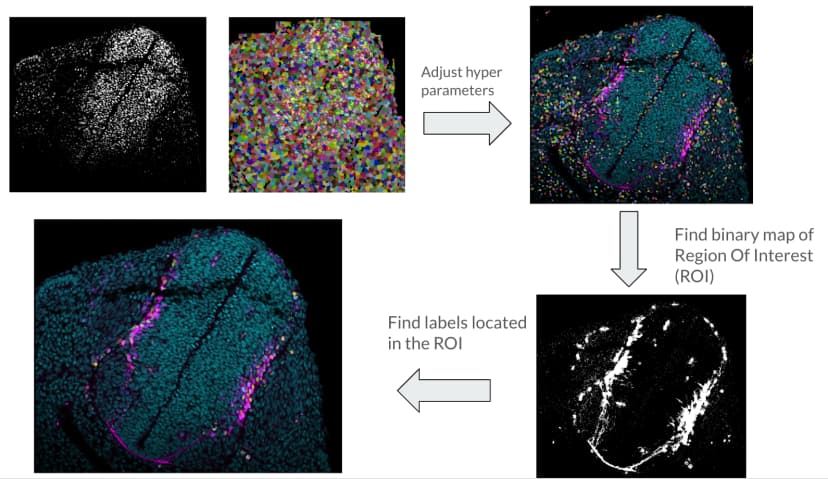
Unsupervised Cell Segmentation in 3D Data
Department of Neuroscience, Alexander Jaworski
A 3D visualization pipeline and application that researchers use to identify, label, and count cells in mouse brain scans.
CCV's Role
CCV was responsible for developing a Python-based application that integrated pre-trained deep learning models to analyze 3D image data for automated cell segmentation and structured result generation. The project included implementing a complete processing pipeline, integrating the application as a plugin within Napari, and deploying the final solution on the lab's PC for routine use.
Contact Us
Need help with your project?
- Initial Consultation: If you’re unsure whether working with CCV is right for your lab, or if you have any other questions, you can
schedule a consultation with us by sending an email to
support@ccv.brown.edu.